

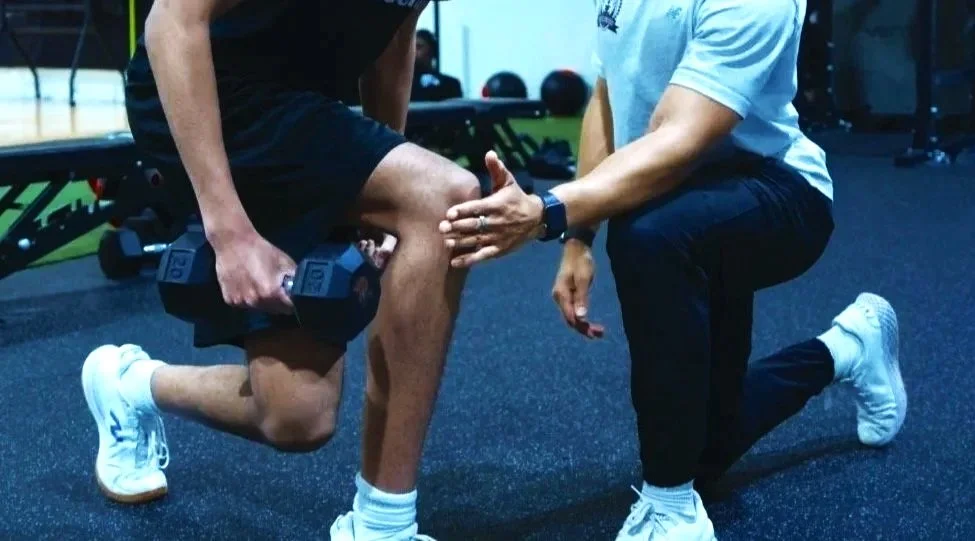
It's not just about getting faster or stronger. It's about protecting everything you have already worked for, and building a body that can carry you through a full season. Not just the first few weeks.
I have this conversation multiple times every season.
An athlete or a parent reaches out at the beginning or mid-season and they're hurt with something nagging. Not necessarily from one catastrophic moment, but from months of accumulated stress on a body that was never really prepared for the demand the sport was asking of it. An ankle that's been tweaked three times. A knee that never fully recovered. Tight and painful hips. A hamstring that doesn't feel great. Fatigue that set in and never left.
And the hardest part of that conversation isn't the injury itself. It's knowing that it was manageable, and in most cases preventable to a degree.
Training isn't always about bigger, faster, stronger. It's also about the idea that we can prepare athletes so well that the sport becomes less dangerous, not more.
The body keeps a running tab
Here's something most people don't fully appreciate or take into account: sport is violent on the body. Not in an obvious way, but in a slow, cumulative way that doesn't show up until it does; and then it shows up all at once.
A basketball player jumps 50 to 100 times per game. A soccer player changes direction hundreds of times in 90 minutes. At maximum running speed, the body absorbs forces of 2.5 to 3x its own body weight with every single stride, and that load increases as fatigue sets in and mechanics break down. Every one of those movements deposits stress into joints, tendons, and soft tissues. The body is incredibly adaptive, but only up to a point, and only if it's been prepared to handle those demands.
The data on what actually breaks athletes down tells a clear story. Sprains and strains are the single most common injury category across all high school sports, accounting for nearly 37% of all reported injuries. At the collegiate level, they account for over half of all injuries requiring more than a week away from competition. These are soft tissue injuries. Muscle pulls. Ligament sprains. Tendon problems. The kinds of things that happen when an underprepared body is repeatedly asked to absorb and produce force it was never built to handle.
37%
Of all high school sports injuries are sprains and strains
52%
Of collegiate injuries requiring 7+ days out are sprains and strains
44%
Of all NCAA men's basketball injuries are sprains and strains
Sources: National High School Sports-Related Injury Surveillance Study (2015-2019); CDC NCAA Injury Surveillance Program (2009-2014); NCAA ISP Men's Basketball (2014-2019)
Most of those injuries aren't the result of contact. They're the result of an underprepared body being asked to do things it was never equipped for: braking forces it wasn't trained for, hip stability that doesn't exist, a posterior chain that's never been loaded under real fatigue, physicality it can't handle, and levels of speed it can't match.
When I work with a new athlete, the first thing I'm assessing isn't how fast they are. It's how well they move in a multitude of directions and scenarios, and how prepared their body is to handle what their sport demands of it. Everything else builds from there.
The ACL Picture Specifically
Within that broader soft tissue category, knee injuries deserve their own attention, especially for the Lacrosse, Basketball, and Soccer athletes I work with. The numbers here matter.
~60%
Of ACL injuries occur without any contact
84%
Lower re-injury rate with proper strength and return criteria
Sources: ScienceDirect (2024); JOSPT (2020)
9 to 12 months. That's what an ACL tear costs an athlete in lost time, not counting the long-term effects on confidence, college recruitment, and career trajectory. And the research is consistent: athletes with proper strength and movement preparation have dramatically lower re-injury rates when they do return.
Strong bodies play differently
Something I've watched happen with athletes over and over again: once the physical foundation is there, something shifts. And it's not just physical.
Athletes who are prepared don't play cautiously. They don't protect themselves on drives to the rim, or when attacking the goal, or embracing contact. They don't hesitate or pull up on plays they should finish; they attack the game. There's a freedom in how they move that you can't fake and you can't coach into someone whose body isn't ready.
That confidence isn't just mental. It's physical repetition first, and then it becomes mental. When your body has been trained to feel comfortable and safe in different positions, decelerate under control, and produce force under fatigue, you trust it. And that trust changes everything about how you compete.
“The goal isn't just to make athletes better. It's to keep them on the floor long enough for all that work to actually matter."
The long game: performing at the end, not just the beginning
One of the most common patterns I see in youth sports is the athlete who peaks early in the season and declines. By late season they're managing fatigue, nursing things that never fully healed, and as a result, going through the motions.
The athletes who don't follow that pattern, the ones who are sharper during post-season play than they were in week two, didn't get lucky. They built a foundation before the season that their body could draw from. They managed their load during the season. They recovered with intention.
That's what performance training is really about. Not just getting your numbers up before tryouts. It's about building an athlete who can sustain, who holds up under a long season, and who shows up to the biggest moments with something left in the tank.
That's the work we do at HalseyPerformance. And for the athletes and families I've had the privilege of working with over the last nine years, it's made the difference not just in their stats, but in the opportunities they've gained, and how long and how well they get to keep playing the sport they love.
Train with HalseyPerformance Working with 350+ athletes across 19 teams. Private training spots available.
